More about Gary Wise
Experience Teaches Us What Matters
Having been an athlete for over fifty years, I believed that KPI-based training clearly determined outcomes: set the standard, train accordingly, and the result would reveal the truth. It seemed straightforward and objective until I questioned what a KPI truly is. Around 2015, within the Adaptive Performance State framework, I defined a KPI called Rate of Perceived Awareness. It served as a reflective standard, allowing an athlete to look back on a specific moment in training or competition and quantify where their attention actually was. It was a simple way to train themselves to recognize, in the present, that they were better equipped to identify “what’s important now,” or what matters.
A key performance indicator is essentially a quantifiable measure that reflects progress toward a goal. The challenge isn’t the definition itself but the perception and interpretation associated with it, a facet rarely discussed in textbooks. Ultimately, perception is central to how we receive information, contextualize it, and extract what is relevant to formulate a plan forward with only the necessary emotional attachment. A missed putt, goal, or time-trial mark is merely information, nothing more. Whether it’s a dropped catch, a marketer claiming they will reach a certain sales volume or price point, or a coach suggesting you have the potential to play at a specific university, each is simply a piece of data. On their own, they carry little inherent meaning. So, where do KPIs fit in? They serve as standards or benchmarks that help us gauge progress more realistically and with less emotional influence. Their purpose isn’t to reveal the absolute truth but to provide a stable reference point as you interpret and find the truth yourself.
Many years ago, when I set a few indoor world rowing records, some thought I was a bit crazy. I didn’t follow the usual standards, like the 500-meter split or strokes per minute. I still valued these metrics; they are important, and I never disregarded them. But during those intense efforts, with my heart pounding around 200 beats per minute, I needed a simpler focus. So I created my own mental anchor: ten meters per stroke. I broke the 500 meters into five sets of ten strokes, for a total of fifty. No complicated calculations, no real-time interpretation, just count and pull. The key performance indicator remained the same; what changed was how I perceived and used it at crucial moments. That is the whole essay, really, compressed into a piece of training apparatus (a Concept 2 rower) in a gym, a quarter of a century ago. But it took me a long time to see where it led.
Today, I see junior golfers carrying rankings, handicaps, wins, strength-of-field data, stats apps, and opinions from coaches, parents, recruiters, and social media, all shaping their view of their place in junior golf. I see college players skipping tournaments because the WAGR strength-of-field profile is too low, and they are unwilling to risk dropping 5 places if they do not win. Almost none of this was created by, for, or requested by them. What truly matters? Who genuinely asks the athlete? Honestly, not enough time, effort, or concern is spent on discovering what the athlete values. Instead, we hand them everyone else’s KPIs and call it growth.
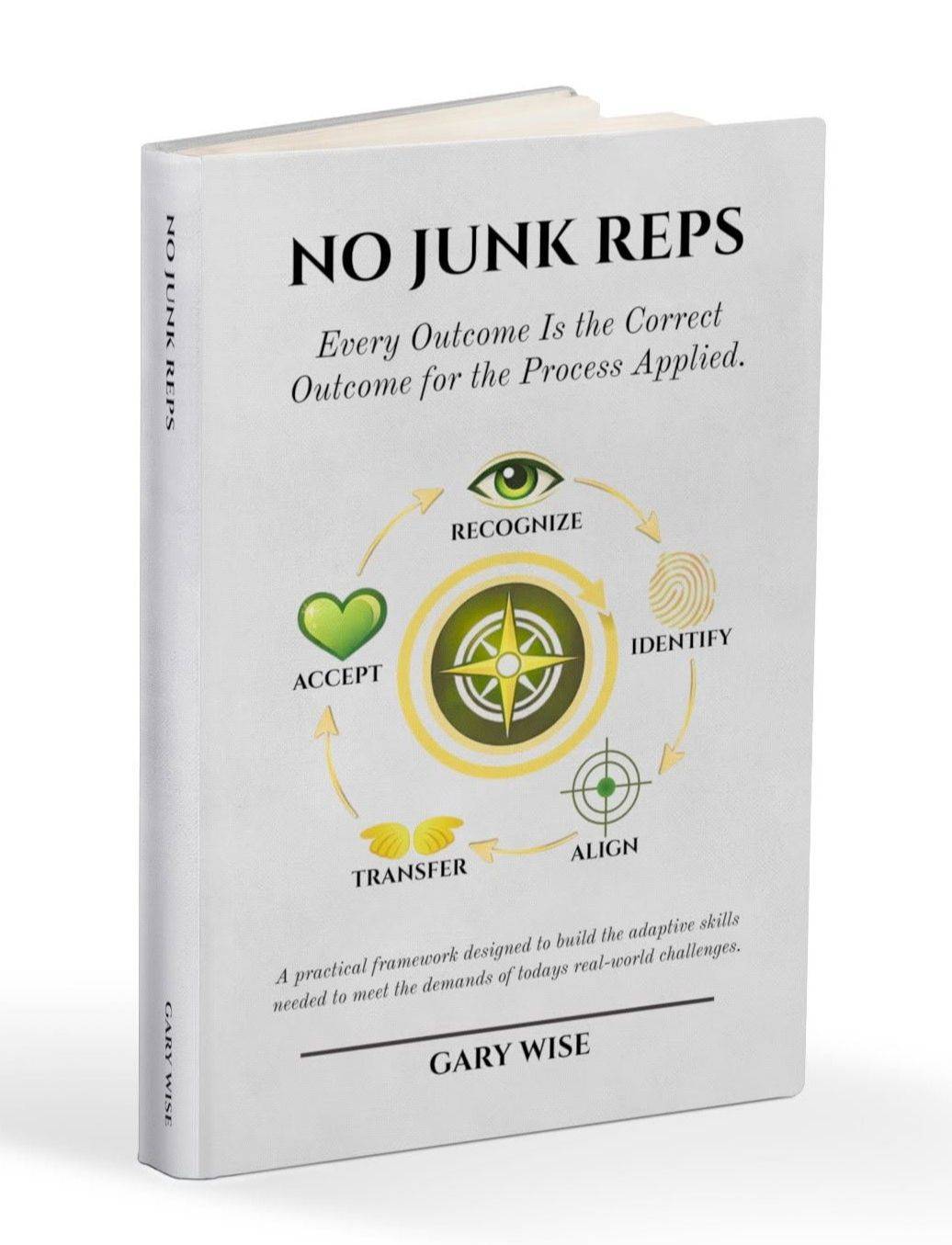
The core idea behind Adaptive Performance State (APS) and my recently released book No Junk Reps® is that awareness begins with recognition. In the APS Framework, Recognize is the initial step: observe before reacting (habitual pathway), serving as a pause to cut through the noise and respond so as to truly see what is present. However, recognizing only opens the door to awareness. The next stage, identify, is what this narrative emphasizes: it is defined simply as “interpret what matters.” This is not about what matters to the ranking system, the recruiter, the algorithm, or the crowd. It’s about what matters to the performer, in this moment, on their path to achieving their goal.
I view the mind-management aspect of performance as a set of perceptual opportunities, each with an open tab. These tabs include rankings, expectations, last week’s round, next week’s recruiter call, a new swing thought, or an unanswered text message. Managing all of these, what I call mind-tab management, isn’t about shutting every tab or reaching zero. Instead, it’s about recognizing which tab truly matters at the moment and having the discipline to focus on it until completion. This embodies personal leadership in its most practical form: not determined by a title or speech but by the consistent, honest, and intentional choice of what matters and by living as if you mean it. Combining recognition, interpretation, decision-making, planning, contextualization, communication, feedback, mind-tab management, and personal leadership yields what Bill Nelson and I call mind-management awareness: the ability to identify what truly matters in each moment and season and to control your attention, standards, and actions accordingly. This isn’t about talent or confidence; it’s a skill that, like the skills discussed in No Junk Reps and APS, can be developed through training.
Why What Matters Is the Perception That Runs Underneath Everything Else
Once you accept that “what matters” is a matter of perception rather than an unchangeable fact, your view of almost every adaptive behavior a performer needs to adopt shifts. For instance, decision-making is not just about choosing between options at a given moment; it involves identifying the most important factor at that time and letting it guide your choice. Similarly, strategic planning follows the same logic over a longer period; it’s about determining what will be significant next month or next season before immediate pressures sway your judgment. Furthermore, the ability to contextualize, reading a situation based on its actual nature rather than its surface, can be seen as applying “what matters" to specific circumstances rather than a broad rule.
It also shows in how we interact with others. Effective communication happens when one person sincerely shares what matters to them, and feedback occurs when this exchange flips: when someone else offers their view of what mattered in your performance. This feedback is meant for you to consider, not to follow blindly. Whether it’s a coach, teammate, stat sheet, or parent, none of these figures can determine what actually matters to you. They can only share their perspective, and how you choose to respond remains your decision.
Why Mind Management, and Why Now
Bill Nelson has spent over twenty years developing his Mind Management platform, making it one of the leading mental performance programs for athletes today. For almost a decade, Bill and I have worked with many of the same athletes, often noticing that the crucial question, what matters most to this athlete right now, is frequently overlooked in many programs and by many coaches. To address this, we are teaming up. Under the Mind Management brand, we are merging our efforts into a single platform: a new Mind Management portal and an upcoming app designed to keep this question front and center for the athlete, rather than an afterthought. This isn’t a sales pitch dressed up as an essay. It’s an honest account of where this all comes from: a goal, a stroke count, fifty years of competing, and a simple, strong belief that no ranking, handicap, or opinion should decide what matters before the athlete has been asked. If that belief is one you share, Mind Management is where we’d like to keep asking the question together.
Live Well, Play Hard
Gary Wise
Gary Wise is available at: surf.sport@yahoo.com and https://www.facebook.com/garywise.mpc/about/